
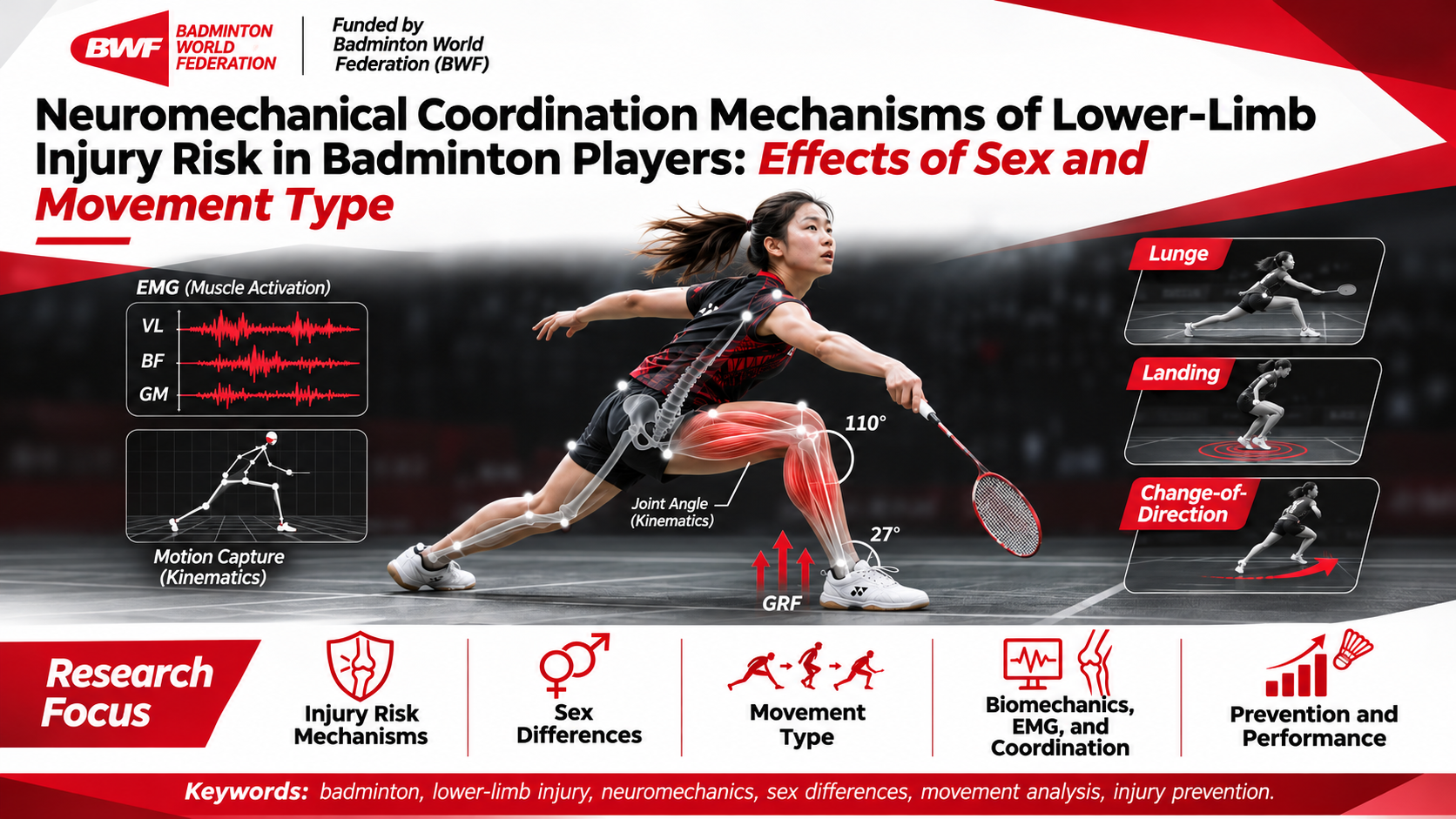
Neuromechanical Coordination Mechanisms of Lower-Limb Injury Risk in Badminton Players: Effects of Sex and Movement Type.
Project Overview: This project investigates the neuromechanical mechanisms associated with lower-limb injury risk in badminton players, focusing on sex-specific differences and movement-dependent coordination strategies. Using 3D motion capture, force plates, and electromyography (EMG), the study examines lower-limb biomechanics, muscle activation patterns, and neuromuscular coordination during badminton-specific movements, including lunging, landing, and change-of-direction tasks. Key Research Objectives: Identify movement-specific biomechanical and neuromuscular characteristics associated with injury risk. -Examine sex-related differences in lower-limb coordination strategies. -Investigate task-dependent modulation of neuromuscular coordination. -Provide scientific evidence to inform injury prevention and performance optimization strategies. -Expected Outcomes: Improved understanding of sex- and movement-specific injury risk mechanisms, supporting evidence-based training, injury prevention, and athlete performance development.
Team

Siddartha Bikram Panday시다르타
PI
Gagan B. Pradhan가간
Post DocWearable sensors · Flexible electronics · Energy harvesting

Zhengyi He하정의
PhD StudentSports biomechanics · Neuromechanics & motor control · Musculoskeletal modelling & simulation

Xinghan Li이성한
PhD StudentTissue & joint mechanics · Sports performance analysis · Strength & conditioning

Zijian Jin김자건
PhD StudentSports biomechanics · Foot & ankle biomechanics · Tissue & joint mechanics